
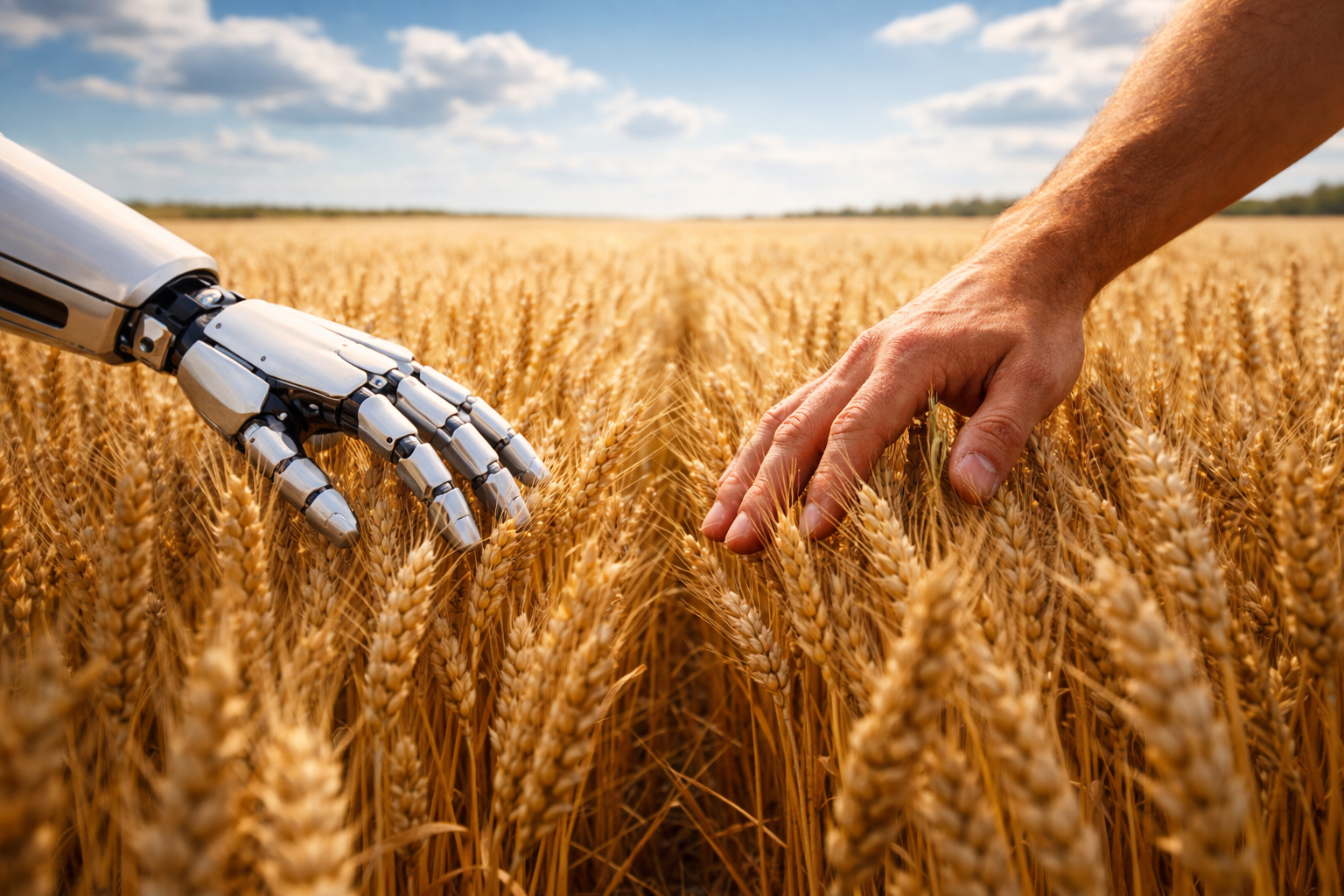
What happens when farming knowledge moves from hands and fields into software and servers?
Farming is not just a technical activity but a lived, learned practice, built over years of being in fields and barns – noticing patterns, smells, textures and subtle changes over time. Much of what makes farmers effective is linked to tacit and experiential knowledge: forms of know-how that develop through observation, repetition and learning by doing.
In my recent paper Digitalization and Skills in Agriculture, I argue that digital tools – from simple smartphone apps that help farmers to identify pests or fine-tune feed ratios to sophisticated farm-management platforms and fully automated tractors and greenhouses – increasingly intervene in this learning process.
They have the potential to erode farmers’ skills and judgement, but also to enhance them. Which outcome prevails depends not on the technology itself, but on how digital tools are designed and how they interact with the ways farmers sense, interpret and act in the world.
Debates about digital agriculture often focus on whether these technologies are “good” or “bad” for farming. A more considered question is how they reshape the basic processes through which farming knowledge and skills is formed and applied in the first place. To understand this, it is useful to think about farming as a continuous cycle of sensing, analysing and acting – a cycle that both humans and machines now perform, but in very different ways.
Farming as a cycle of sensing, analysing and acting
Farmers require a remarkably wide range of knowledge and skills. They diagnose plant diseases at the crop level, select soil-fertility management strategies at the field level and make strategic investment decisions for the entire farm. While some of this expertise comes from formal education, much of it is acquired through embodied experience. Over time, farmers become experts on their own farms, able to make intuitive yet highly informed decisions based on this accumulated knowledge.
These activities can be understood as part of a continuous sense–analyse–act cycle. Farmers sense what is happening in their fields and barns using their eyes, hands and other senses. They analyse this information, drawing on experience, discussion with others and sometimes formal data. They then act – applying inputs, treating animals, or making management decisions. These actions change conditions on the farm, generating new information that must again be sensed. Through repeated engagement with this cycle, farmers are continuously refining their knowledge and skills.
Digital agriculture is designed around the same basic logic. Digital tools sense by collecting data, analyse by processing and interpreting that data and act by recommending or executing decisions. The critical question is not whether machines can perform these functions, but how their way of sensing, analysing and acting differs from human practice – and what happens when parts of this cycle are delegated to algorithms and automated systems.
Sensing: data collection and sensory engagement
Many forms of digital agriculture – such as automated tractors, milking robots, or climate-controlled greenhouses – depend heavily on remote and proximal sensors. These technologies intervene in the “sensing” stage of the sense–analyse–act cycle.
By collecting large volumes of data in real time, they can reduce the need for farmers to be physically present in fields or barns, shifting work towards screens, dashboards and management software. Scholars have raised concerns that this distancing may undermine opportunities for observational and experiential learning, which depend on being present and engaged with the physical environment.
Not all digital tools, however, remove farmers from the field. Some applications require farmers to become “humans as sensors”. For example, apps like Plantix in India require farmers to take photographs of crops or pests. These tools still require physical presence, but they may alter how farmers attend to and interpret what they see. Some scholars worry that, over time, reliance on such tools could diminish farmers’ ability or motivation to read natural indicators.
Some scholars also argue that sensors may not replace but complement human sensing. Farmers may use digital information – such as soil maps created with the help of sensors – with embodied, experiential practices like seeing, feeling and smelling the soil, creating hybrid forms of knowledge, allowing more informed decisions.
Analysing: decision support and the risk of replacement
The analysing stage of the cycle is where digital agriculture most visibly promises benefits.
Many forms of digital agriculture are designed to support analysis and decision-making – from operational and tactical decisions at the crop and field level to managerial and strategic decisions at the farm level.
More “passive” tools provide farmers with information such as market price updates, weather reports, or soil maps, which may empower them to make better informed decision. More “active” tools diagnose problems, present alternative scenarios, suggest optimization strategies, or even prescribe solutions.
There is ongoing debate over whether some of these tools have crossed the fine line between supporting and replacing human decision-making. When analysis is increasingly delegated to algorithms, farmers may lose opportunities to practice judgement and intuitive decision-making – a dynamic described as a “use it or lose it” problem.
At the same time, there is evidence that farmers do not necessarily use digital tools in deterministic ways. Some treat them as learning tools, using outputs as a starting point for discussion with peers or advisors. Tools that provide background information, encourage interpretation and leave room for judgement are more likely to strengthen knowledge and skills than those that offer closed, prescriptive answers. The impact depends on whether digital systems position farmers as active participants in analysis or passive recipients of algorithmic conclusions.
Acting: automation, feedback and learning
Automation intervenes most directly in the acting stage by delegating or entirely removing farmers’ decision making and physical execution of tasks. Autonomous tractors, robotic weeders and automated barns can take over routine operations with minimal human involvement.
Commentators suggest that, inasmuch as “the farm space could be represented digitally and managed through AI”, these systems could fundamentally reshape agriculture.
Although automation comes with great risks of reducing farmers’ physical presence in the field or barn, which can affect sensory engagement and action-feedback learning, studies in already highly automated sectors like livestock farming also suggest that it can relieve farmers of labour-intensive routine tasks, many of which offer limited experiential learning.
In turn, this may create opportunities for deeper sensory engagement or more “meaningful work requiring creativity or other kinds of cognitive capacity” . Some argue that automation allows farmers to upskill and focus on more strategic and analytical roles.
Again, the key issue may not be automation itself, but how it interacts with the learning loop. When action is removed entirely from farmers’ hands, the feedback that links action back to sensing may weaken. When automation is designed to keep farmers meaningfully involved, it may support rather than undermine learning.
Disempowerment is not destiny
The effects this could have on farmers’ knowledge and skills remain heavily debated. Critics warn that this shift could erode farmers’ experiential expertise and leave them more dependent on agribusiness and technology firms – even turning them into “contract workers on their own land”, or “cyborg” farmers embedded in systems of sensors, software and data flows.
Others are more optimistic. Agricultural history is rich with examples of farmers obtaining new knowledge and skills in response to technological change. From this perspective, such tools could empower farmers with new managerial and strategic capabilities by improving access to valuable information and analytical aids and create opportunities for learning and creative thinking.
Digital agriculture can remove farmers from the sense–analyze–act cycle, raising the risk that it erodes knowledge and skills by reducing hands-on experience and by prescribing or automating decisions. But these outcomes are not inevitable.
Keeping farmers in the loop
Designers, like farmers, must understand the landscape in which they work. Humans and machines may appear to perform the same functions – sensing, analysing, acting – but they do so in fundamentally different ways. Treating machine-based processes as equivalent risks misunderstanding what is lost or gained when parts of the cycle are delegated to digital systems.
Sensitive design can support farmers learning throughout the sense–analyse–act cycle – especially when they position users as active participants rather than passive recipients of pre-packaged, deterministic solutions. For example, plant health apps such as Plantix mentioned above can either strengthen or weaken farmers’ diagnostic skills and knowledge of plant health management. Tools that provide background information on pests and diseases, inform about integrated management strategies and encourage the integration of farmers expertise are more likely to enhance knowledge and skills than those that offer prescriptive recommendations such as suggesting the most effective pesticide.
The same is true regarding the design of more sophisticated farm management support systems and automatized systems. Here, hybrid intelligence, where humans remain in the loop, can reduce negative effects on farmers’ knowledge and skills or even foster upskilling.
Because such design choices may not align with the commercial interests of tool developers, governance is crucial. Policies addressing issues such as data sovereignty and market concentration, combined with efforts to build farmers’ digital literacy, are essential. Like past agricultural revolutions, digital agriculture is reshaping farmers’ knowledge and skills – but whether this transformation erodes these skills or strengthens their autonomy depends on how deliberately it is steered.
- Thomas Daum is an Associate Professor at the School of Global Studies at the University of Gothenburg in Sweden. His research focuses on sustainable agricultural development and food system transformation, with a particular emphasis on innovation and governance.
- The open access paper Digitalization and Skills in Agriculture is available at this link
- Image: ChatGPT