
What do we cultivate when we choose digital agriculture?
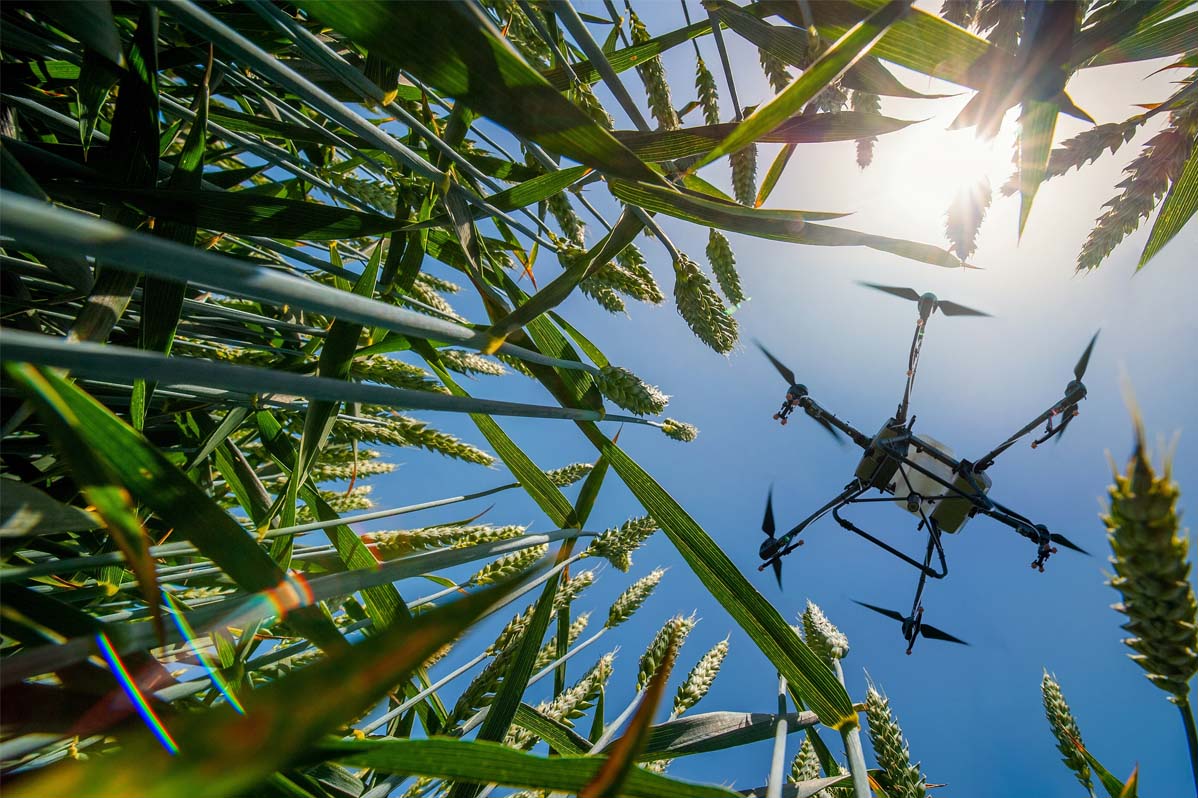
A quick online image search on the future of agriculture paints a clear picture: soon, crops will be planted and harvested by robots, fields will be sprayed with surgical precision by automated drones, and fields will be highly monitored through AI platforms accessible from the comfort of farmers’ tablets and smartphones.
While this reality is still far from what most farms look like today, corporations, philanthropies, governments, and international institutions are heavily investing in the digitalisation of agriculture. To many, digital tools are the most obvious, if not inevitable, approach to make food systems more efficient and sustainable.
There is certainly a reason for the hype. Digital tools are helping farmers access new markets, prices, weather information, and manage their farms. Yet the glow of the digital farm easily conceals the broader systems that make it possible. While some farmers, researchers, NGOs, and public institutions are developing accessible, open-source, and transparent digital tools, agricultural digitalisation is mainly led by agribusinesses with the support of tech companies. Behind every platform are also the minerals, electricity, water, workers, and infrastructure that sustain it.
The reflections that follow emerge from the publication of IPES-Food’s recent report, Head in the Cloud: Challenging the False Promise of Digital Agriculture and Cultivating Innovation from the Ground Up. The report considers how corporate-led digitalisation is reshaping food systems and sidelining the many farmer-led and community-based forms of innovation. Yet the report was not an endpoint in our analysis, but an invitation for further conversation on the choices we make in signing up to a corporate digital future.
Digitalisation on the farm
The digitalisation of farming refers to the increasing integration of digital tools and data analytics across the agricultural sector. At the farm level, this can involve collecting soil moisture data, monitoring pest or disease activity, tracking livestock, observing crop growth, or analysis of fertilizer or pesticide application.
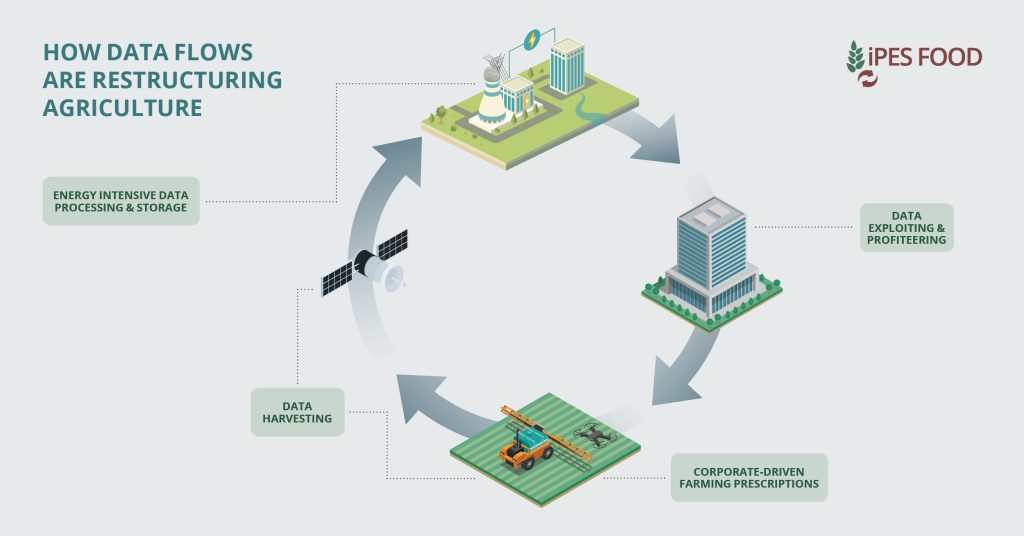
In practice, digitalisation involves the collection and analysis of data. When a farmer drives a precision spraying tractor purchased from major agribusinesses, field-level information is harvested by proprietary technologies, transferred to private cloud storage, and processed by opaque algorithms to generate spraying recommendations. This advice is often only accessible to farmers via subscriptions-based platforms. While presented as technological progress, this process is as much – if not more – about expanding corporate control as it is about improving agricultural efficiency.
As our report shows, agricultural data has become a new source of power and profit. With the help of AI, corporations can commodify and assetize this data by using it to inform their R&D, refine targeted marketing strategies, or sell it to third parties. Machinery, seed, and input companies are moving beyond selling products, increasingly centring their business models on providing digital services – and controlling the data generated through their use.
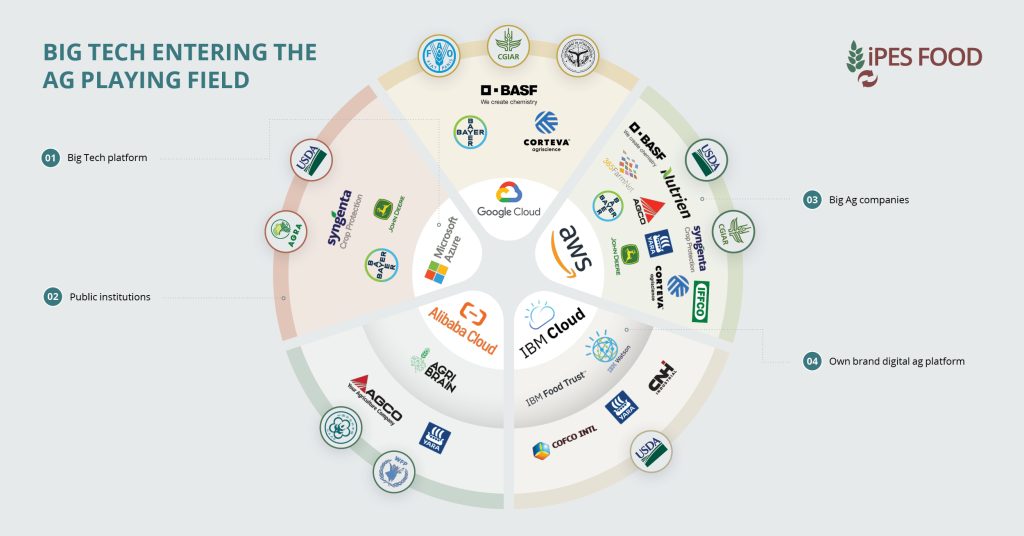
This data grab is also extending beyond agriculture to the companies providing the digital infrastructure on which these technologies depend. Today, Amazon, Microsoft, and Google own 63% of global cloud services, making it almost impossible to deploy digital agriculture at scale without relying on their infrastructure. Agribusinesses have therefore spent recent decades building alliances with Big Tech: Bayer’s Climate FieldView platform relies on Microsoft Azure; Nutrien partners with Amazon Web Services; and Corteva collaborates with Google Cloud. The result is a concentration of power across the agricultural and digital sectors.
What corporations gain in power, farmers lose in autonomy and control. Corporate-led digital technologies are deliberately designed to deepen the “technological treadmill” of farmer dependency on corporate products and services. A farmer who previously fixed their own tractor with locally available parts must now rely on an affiliated technician to unlock licensed software. And these lock-ins are already reaching the next generation of farmers: a young farmer taking over a farm may no longer just be inheriting farmland and equipment, but also technology contracts, systems, and subscriptions they must keep paying for to keep their farm up and running.
The material requirements of digitalisation
Behind digital agriculture technology not only hides power, but also the extensive physical requirements on which digital systems depend. Digital agriculture is often made to feel immaterial, as though it carries little weight or physical consequence. Data is gathered “remotely” from the farm, stored in the “Cloud”, processed by “artificial” intelligence before advice makes its way to farmers’ screens. Yet digitalisation is anything but immaterial.
Firstly, digital agricultural systems rely on data centres whose water and energy demands are immense. By 2030, global data centres’ electricity consumption could rival that of Japan’s. Fossil fuels account for more than 55% of the electricity sources used by data centers worldwide. In 2024, Google alone withdrew 7.7 billion gallons of potable water for its data centers. Despite these high energy requirements, the tech industry is ploughing ahead with plans to construct massive data centres to meet increasing demands for AI – demands that become harder to justify as record-breaking droughts around the world this year.
Secondly, every battery, semiconductor, computer, and smart phone requires critical minerals overwhelmingly mined in the Global South, including cobalt from the Democratic Republic of Congo, lithium from Bolivia, copper from Chile, or coltan from Rwanda. Mining is considered one of the most polluting and dangerous sectors in the world, contaminating soil and water, decimating biodiversity, exposing communities to severe health consequences, displacing people from their land, and destroying local livelihoods.
Finally, the AI prescriptions depend on data labelling work. Millions of data labourers categorize information, transcribe content, label images, and verify information for algorithms to learn from. This work is often outsourced to countries in the Global South, including in Brazil, Colombia, India, Kenya, Pakistan, the Philippines, Uganda, or Venezuela, where workers face conditions often resembling “modern slavery”.
There is no intangible “cloud”. There are workers, mines, water, and land.
Reflections on sitting with discomfort
Once we recognize that adopting digital technologies in agriculture – and elsewhere – can mean buying into a system of corporate power and exploitation, essential questions emerge. Under what conditions could digital technologies be fair and sustainable? Is that even possible? How do we sit with the fact that society is now so deeply dependent on corporate digital systems that rejecting them is not, for most people, a realistic option?
We do not deny the fact that digital tools can be useful nor that they play an important role in our lives. We use them to write this article, to communicate, to share information, and even to collaborate to take collective action against them – or at least to better regulate them. Yet, we remain trapped in debates about whether to adopt specific digital technologies, or how to improve them.
Rather than debate the utility of a specific technology, we should move the conversation towards the kinds of agricultural systems and societies we want to build, and the kinds of lives we want these systems to support.
Spaces of collective reflection are particularly valuable to nourish these discussions – not to find consensus, but to discuss the conditions required for dignifying livelihoods across the world. Crucial to these efforts is involving people most affected by digital infrastructures, including Indigenous Peoples, peasants, and miners. An inspiring example is the recent gathering “Earthkeepers vs AI empires” in Zambia, where more than one hundred people, from farmers to tech justice activists, gathered to organize against the expanding power of Big Tech.
Most of us are already entangled in digital systems built on exploitation and environmental degradation. Collectively sitting with this discomfort could help us adopt a more critical relationship to digitalisation – reminding us that we do have agency over how it unfolds and who it serves.
As current geopolitical tensions and the climate crisis urge us to question our reliance on food and agricultural systems controlled by a small number of powerful actors, it becomes all the more important to consider pathways that are more participatory, locally grounded, and centred on justice. Other agricultural and societal futures are desirable and possible. Many of them already exist today.
- Chantal Wei-Ying Clément is Senior Programme Manager and Saskia Colombant is Associate Programme Manager at the International Panel of Experts on Sustainable Food Systems (IPES-Food), an international non-profit think-tank guiding action for sustainable food systems around the world.
- IPES-Food’s report, Head in the cloud: challenging the false promise of digital agriculture and cultivating innovation from the ground up, is available here.
- In-article graphics courtesy of IPES Foods